
Spatiotemporal multi-omics offers a groundbreaking perspective on the fundamental building blocks of life, enabling scientists to measure gene activity in tissue samples across space and time with unparalleled specificity. This game-changing approach builds upon the achievements of single-cell sequencing by elevating it to the next level, allowing researchers to track a cell’s precise location and its intricate interactions with neighboring cells. This can be visualized like the top of a fruit tart, where each piece of fruit is distinctly arranged in relation to the others, creating a complete and organized picture.
At the core of this field lies Spatial Transcriptomics (ST), a cutting-edge biological research method that integrates high-throughput sequencing with spatial positioning data. ST fundamentally addresses the limitations of traditional single-cell sequencing, which inevitably loses the original spatial context of cells within a tissue. By capturing RNA molecules directly from tissue sections and utilizing spatially barcoded probes for sequencing, ST precisely maps the exact expression location of each gene within the tissue's microscopic architecture. Recognizing its transformative impact on biological research, Nature Methods named spatial transcriptomics the "Method of the Year" in 2020.
Stereo-seq
Stereo-seq, BGI Group’s leading Spatial multi-omics technology, is the GPS technology of life. It can help scientists create a map of life, enabling them to see what type of cells constitute an organ, where each cell is, and what is the spatial relationship between different cells. Stereo-seq combines a number of scientific advances and combines DNA nanoball (DNB)-patterned arrays and in situ RNA capture to create spatial enhanced resolution omics sequencing. The biggest Stereo-seq sequencing chip is 13cm × 13cm, which is 500 times bigger than other spatiotemporal omics sequencing chips so that a complete section of tissue can be sequenced. And it has a more than 100 billion pixel resolution, allowing every biological process to be presented at a resolution that has never been seen before.
With these advances scientists can map a full catalog of cell types and cell states, enabling them to examine not just individual cells, but the relationship between all the cells in the body. What’s more, they can even map the cells over time, seeing how they grow and change, organ by organ, and creating physiology atlases.
Technical Principle
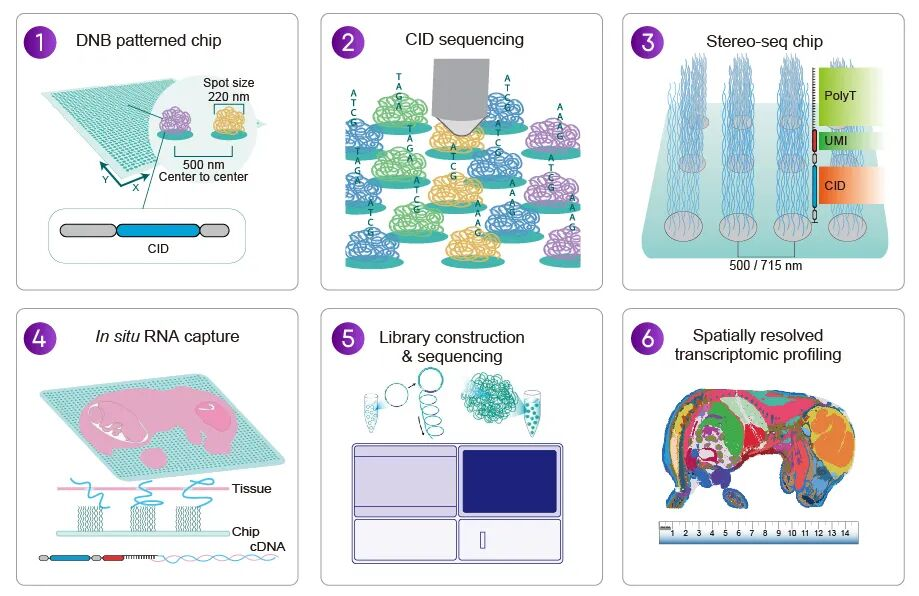
Highlights
1. Nanoscale spatial resolution
Accurate localization down to the nanoscale enables the analysis of spatial gene expression at the cellular and even subcellular level.
2. High throughput & high sensitivity
Supports large field of view, multiple samples and high gene detection coverage, and is compatible with a variety of tissue types (e.g., brain, tumor, embryo, etc.).
3. Multi-omics integration
Spatial transcriptome sequencing, spatial ATAC sequencing, spatial proteome sequencing.
Compatible with multiple species, delivering robust performance in plant, animal, and medical research.
Since major Stereo-seq research papers were published by Cell Press in May 2022, scientific attention to the technology has spread globally. Some of the major initiatives for Stereo-seq include:
Mapping a full catalog of cell types and cell states in their complete spatial context for every organ in the body to create physiology atlases.
Studying the lifetimes of organisms from development from a single cell, growing, maturing and dying will help uncover the biomolecular causality in development atlases and aging atlases.
Gaining a deeper understanding of diseases from cancer to inflammation to degenerative diseases with disease atlases leading to better treatment and prevention.
Mapping biologically diverse organisms to provide unprecedented insights for studying the accuracy of phylogenetic trees.


 WeChat QR Code