
Haplotype
A haplotype refers to a group of alleles located on the same chromosome that are inherited together as a unit. In a diploid individual, homologous chromosomes are inherited one from each parent. Although they are highly similar in macro-structure, they often harbor numerous differences at the nucleotide level. These two chromosomes are not random assemblages of variants; rather, they carry distinct, correlated sets of variation patterns—these two sets constitute the two different haplotypes.
Haplotype Phasing
Haplotype phasing involves correctly assigning alleles (or heterozygous sites) in a diploid (or polyploid) genome to their respective parental chromosomes. The goal is to arrange all alleles derived from the same parent onto a single chromosomal sequence. While short-read sequencing methods struggle with the physical distance between heterozygous sites and chromosome separation in polyploids, single-molecule long-read sequencing technologies provide extended read lengths that overcome these previous limitations.
Applications
Key applications include genotype-phenotype association analysis, inference of population genetic history, and the estimation of critical genetic parameters such as chromosomal recombination rates and hotspots. Furthermore, it is instrumental in exploring recurrent mutations, selection signals, and cis-regulation of gene expression.
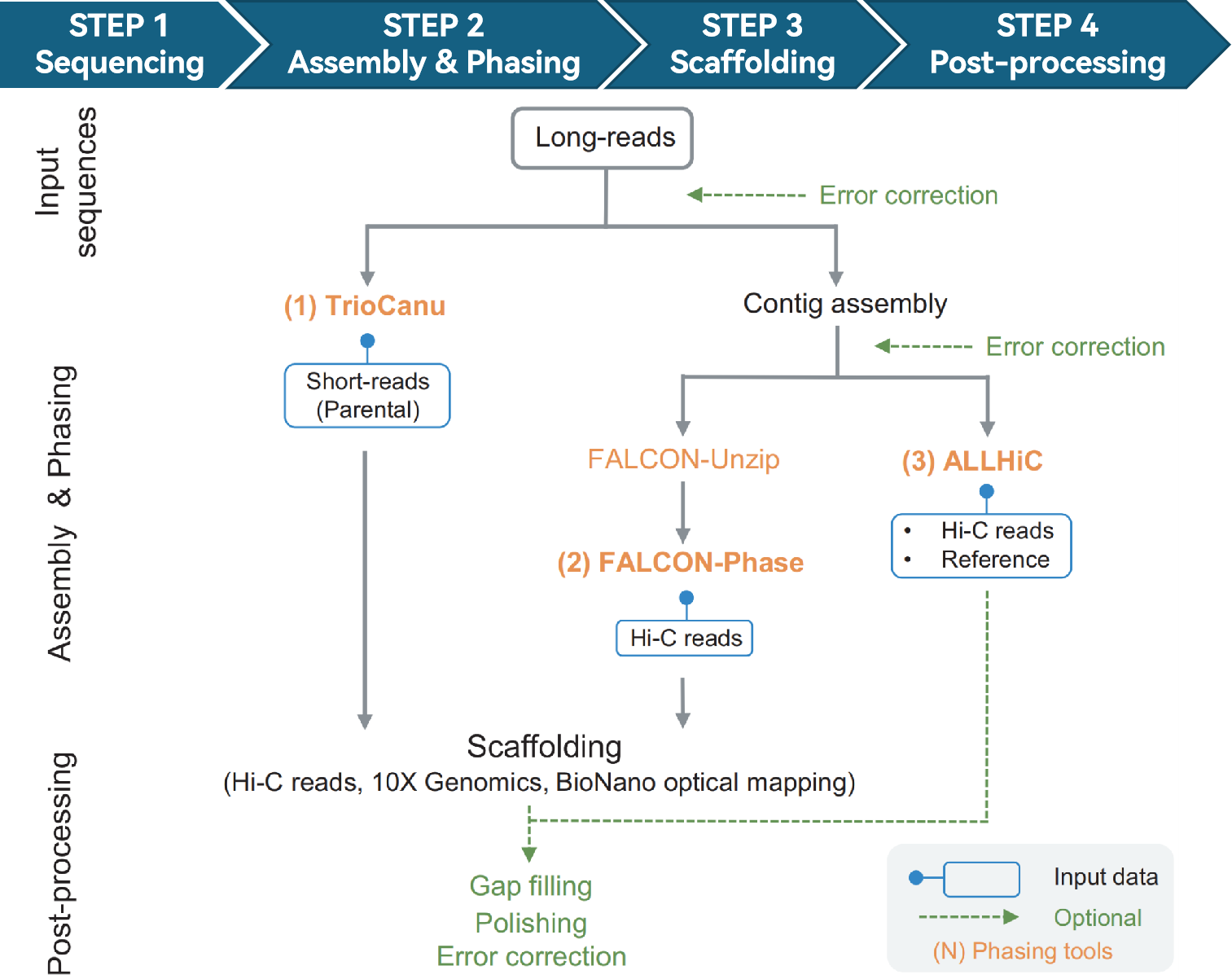
Figure. De novo genome phasing pipelines.


 WeChat QR Code