
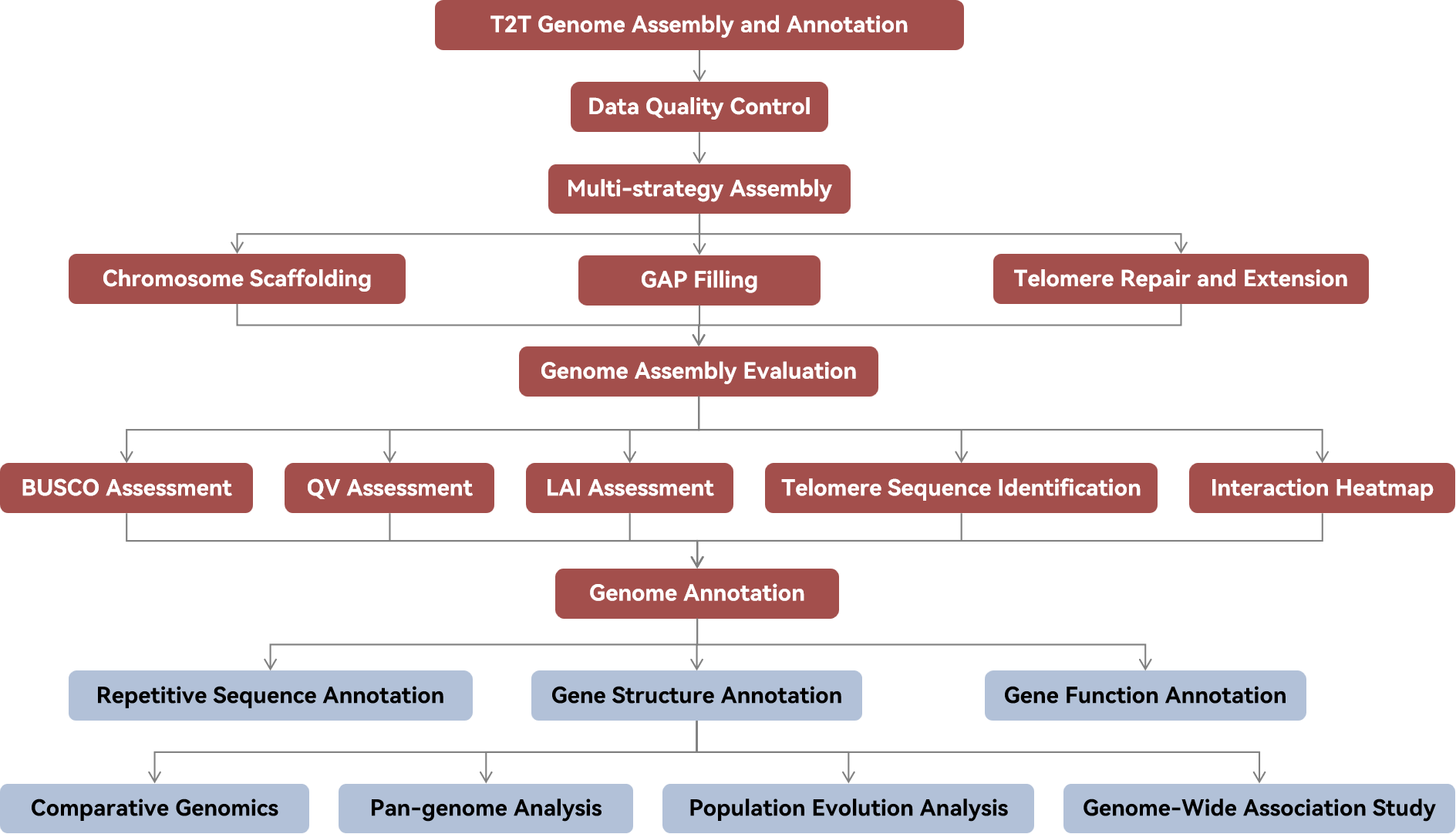
A telomere-to-telomere (T2T) genome refers to a complete genome sequence assembled from one telomere to the opposite telomere of each chromosome, representing high accuracy, high contiguity and high completeness in genome assembly. Leveraging long-read sequencing technologies such as PacBio HiFi and ONT ultra-long reads, combined with Hi-C and other auxiliary technologies, T2T assembly enables in-depth resolution of complex genomic regions, including centromeres and telomeres. The T2T genome not only provides a comprehensive reference for gene function research, but also advances progress in biological, medical and agricultural disciplines. It serves as a powerful tool for scientists to unravel the fundamental mysteries of life.
Applications
1. The telomere-to-telomere (T2T) genome lays a robust and solid foundation for subsequent biological research, offering novel insights into both agronomic traits and disease mechanisms.
2. By conducting comparative analyses with previously published genomes, researchers can explore the origin and evolutionary history of target species and characterize the functions of newly identified genes.
3. T2T assembly overcomes key challenges in the assembly of repetitive sequences and identifies a broader range of previously uncharacterized repeats. Notably, tandem repeats represent a core research focus in medical studies.
4. ChIP-seq, FISH and other validation approaches are applied to centromeric regions, enabling the exploration of genetic information in centromeric and pericentromeric zones, including their structure, function, and methylation profiles.
Technical Workflow


 WeChat QR Code