
Background
CYP2D6 is widely studied in the field of pharmacogenomics (PGx) since it directly impacts the metabolism of ~20% of the most prescribed medications, including antidepressants, opioids, and cancer drugs. Current systems used to translate genotype to phenotype rely on the star (*) allele nomenclature (defining which variant(s) are present in an allele), and the assignment of function to the star alleles (i.e., increased, normal, decreased, or no function) with inferring phenotype based on the identified genotype. Some use the activity score (AS) system (allele activity values: 0=no function, 0.5=decreased function, 1.0=normal function; range 0−1) for phenotyping. Per CPIC guidelines, CYP2D6 AS correlates with phenotype: 0=poor metabolizers (PMs); 0.5=intermediate metabolizers (IMs); 1.0/1.5/2.0=normal metabolizers (NMs); >2=ultrarapid metabolizers (UMs).
However, CYP2D6 is particularly challenging to study due to high levels of polymorphisms and structural variants (SVs), including complete gene deletions and duplications, tandem alleles, hybrids with the CYP2D7 pseudogene, and gene conversion events (PMID: 33143137). Additionally, this region is difficult to capture with short-read sequencing and other genotyping methods due to high sequence identity with neighboring pseudogenes CYP2D7 and CYP2D8 directly upstream, which have 97% and 92% exonic sequence similarity to CYP2D6, respectively.
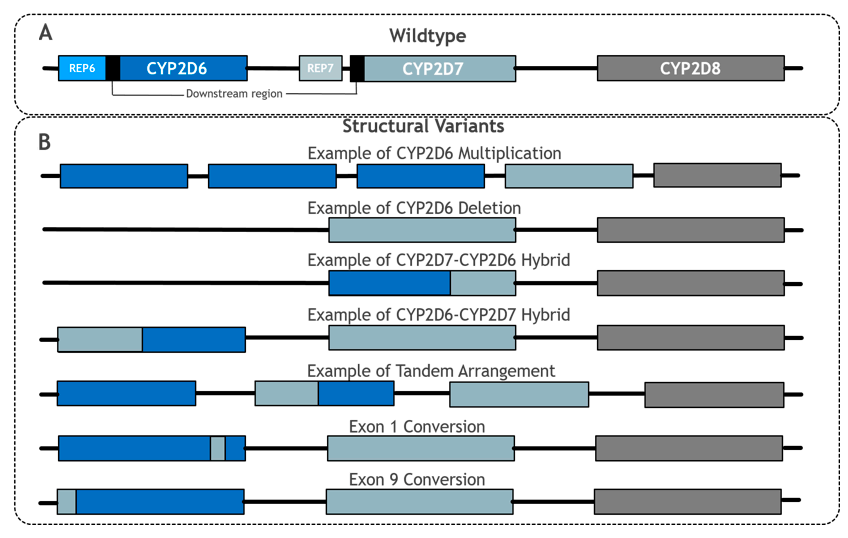
CYP2D6 structural variant types
Comprehensive Analysis of CYP2D6 Genotyping
Using PacBio HiFi long reads, we developed a custom workflow for accurate detection of the highly polymorphic CYP2D6 locus. It spans homologous regions, directly captures haplotype data, and simultaneously detects all variant types (SNVs, Indels, CNVs, gene fusions, rearrangements), enabling comprehensive genotyping from base to structural level.

Application Value


 WeChat QR Code