Background
Color vision is governed by three cone photopigment genes: OPN1LW (long-wavelength sensitive), OPN1MW (middle-wavelength sensitive), and OPN1SW (short-wavelength sensitive). Tandemly arrayed on Xq28 and sharing 98% sequence identity, OPN1LW and OPN1MW are prone to unequal homologous recombination—a major molecular driver of red-green color vision deficiency, the most common Mendelian disorder in humans. Characterized by normal visual acuity and normal cone electroretinogram responses, this condition affects approximately 1 in 12 males and 1 in 200 females.
Only a few diagnostic genetic tests are currently available to analyze the OPN1LW/OPN1MW gene cluster. Most tests do not solely target the cluster, but the OPN1LW/OPN1MW genes are tested as part of broader gene panels and analyzed by short-read NGS. Short-read sequencing renders reads of 100-400 bp in length, which are too short to differentiate between the highly homologous OPN1LW and OPN1MW. Moreover, none of the available tests combine copy number and sequence analysis, which is needed to detect the complete spectrum of causal variants. Due to the unavailability of complete genetic testing of the OPN1LW/OPN1MW opsin gene cluster many patients with pathogenic variants stay underdiagnosed. Probably, genetic underdiagnosis contributes to the lack of awareness by clinicians to recognize retinal disease caused by dysfunctional opsin genes.
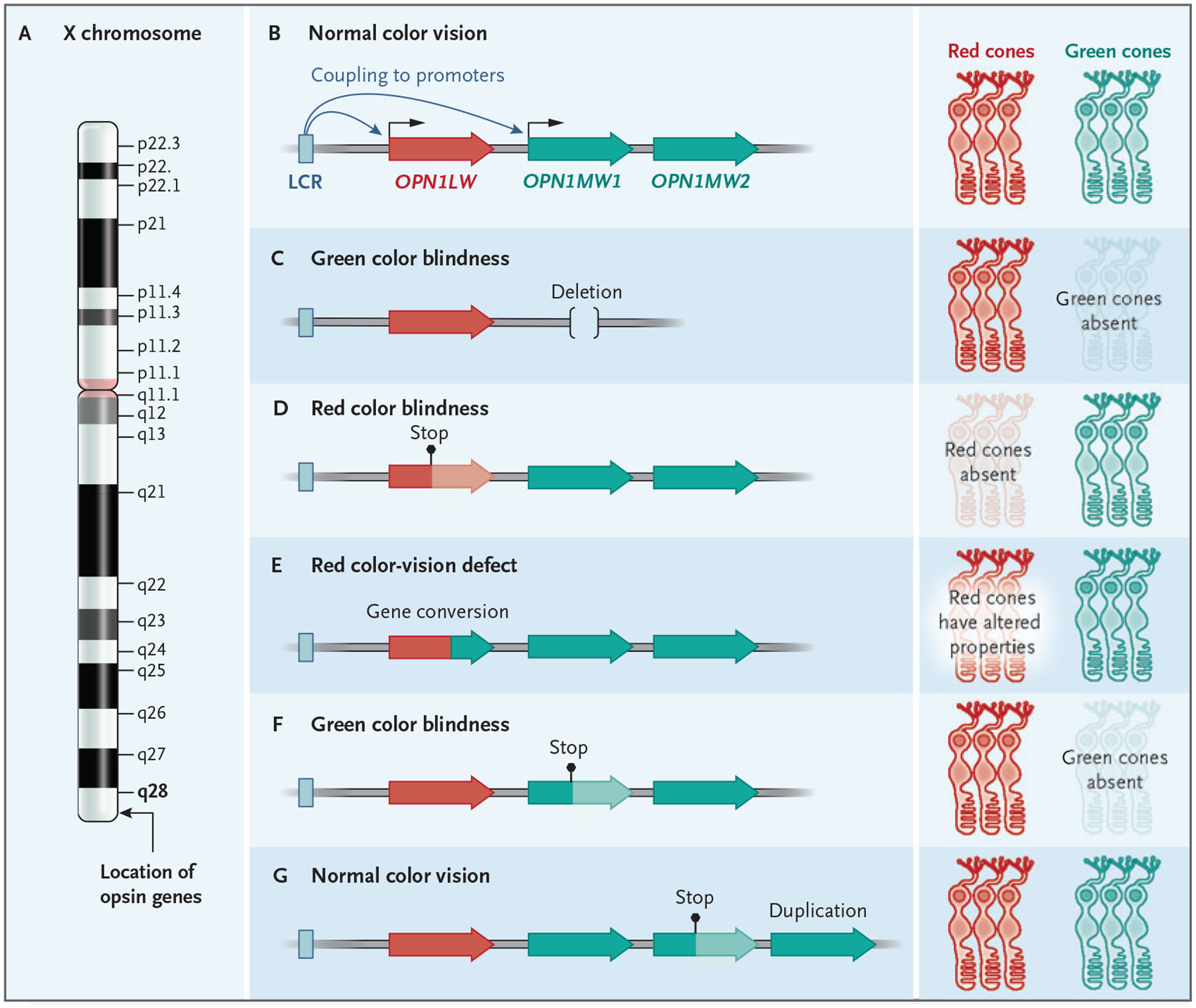
Fig. Structure and Expression of the Red–Green Color Blindness Loci
Comprehensive Analysis of Red-Green Color Blindness
Haorui Genomics presents a proprietary Red-Green Color Blindness genotyping solution, fully optimized for the PacBio HiFi platform. Utilizing four long-range amplicons to span the entire OPN1LW/OPN1MW gene cluster, this system captures full-length sequences to precisely identify complex deletions, recombinations, and fusions. By resolving highly homologous regions and multi-copy arrangements with single-base resolution, it successfully overcomes traditional detection bottlenecks to deliver definitive genetic insights.

Technology: Single molecule real-time (SMRT) sequencing
Platform: PacBio Revio/Vega system
Sample type: Blood, gDNA
Application Areas
1. Vision Screening & Early Intervention
Red-green color blindness arises from inherited defects in cone cell function, and with no definitive cure currently available, early diagnosis is paramount. Timely identification enables immediate intervention to mitigate the impact on learning, lifestyle, and career opportunities. For children, early detection facilitates specialized visual training and personalized guidance, helping them adapt to their condition while preventing psychological distress such as anxiety or low self-esteem, thereby supporting healthy development.
2. Genetic Counseling & Family Planning
By determining the carrier status of both partners, our testing precisely calculates the probability of transmitting color vision deficiency to offspring, providing a scientific foundation for family planning. These insights empower couples to make informed reproductive decisions and prepare for future care needs, effectively alleviating parental anxiety. Ultimately, this service delivers the precise genetic data required for comprehensive counseling, enabling families to assess risks and pursue science-based reproductive strategies.


 WeChat QR Code