1. The Key to Resolving Complex Structural Variations
To date, the most frequently reported mechanism underlying the D-- phenotype is gene rearrangement. While the short-read lengths inherent to NGS limit its ability to detect these structural variations, long-read based assays play a central role in resolving them.
A study investigated a proband with the D-- phenotype and her family. Using the HemoSure® assay and data from 29 heterozygous SNV loci, researchers manually assembled distinct RHCE and RHD gene haplotypes. By combining Bionano Optical Genome Mapping (OGM) with heterozygosity data and pedigree analysis, RHCE haplotypes carrying structural variations were definitively identified and their inheritance patterns within the family were successfully traced.
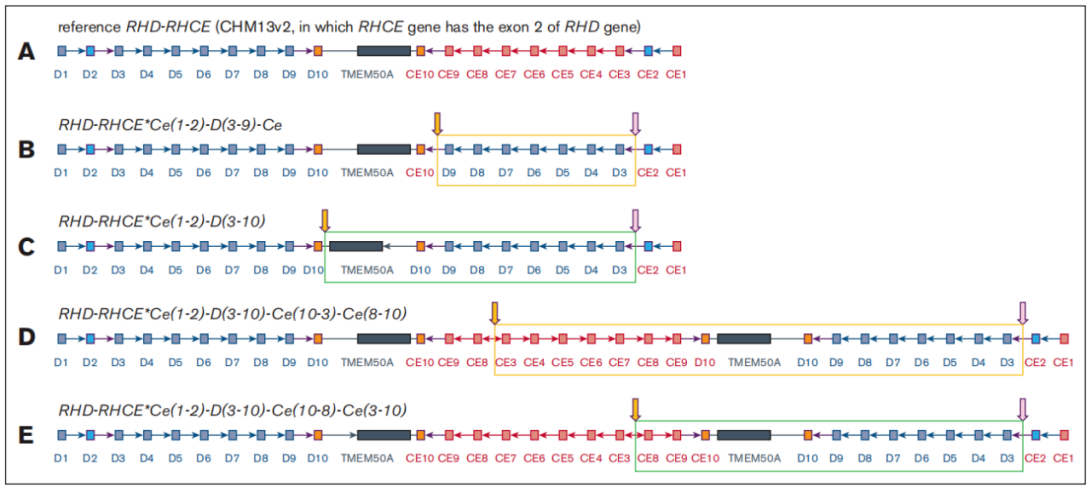
RH and SV haplotype: (A) Reference RH haplotype. (B-C) The SV haplotype of father. (D-E) The SV haplotype of mother.
Reference:Li M, Wang L, Li A, et.al. Blood Adv. 2024; 8:3154–65.
2. 500A>G variation associated with Rhmod phenotype
Patient information: A patient with anemia, manifesting only as a reduction in red blood cell hemoglobin.
Serological testing:

PCR-SBT: The 10 exons of the RHD and RHCE genes were present and no variants. The genotypes were RHD*01/RHD*01 and RHCE*02/RHCE*02.
PacBio HiFi Sequencing (HemoSure®) :

This novel variant maps to the third extracellular ring of RhAG (linked to ammonium salt transport) and may alter epitopes or its interaction with RHD/RHCE proteins, leading to the Rhmod phenotype.
Reference:Hong X, Huang X, Zhang J, et.al.Transfusion. 2025 Feb; 65(2):E7-E9.


 WeChat QR Code