
Case 1: A novel c.29-3C>G variant on the B allele forms the Bel phenotype
Patient information:A 47-year-old female was hospitalized for excessive menstrual bleeding and extended cycle duration.
Serological testing:

PacBio HiFi Sequencing (HemoSure®) :

Results: Intron 1 c.29-3C>G, near the GU–AG splicing AG dinucleotide, may induce alternative splicing and ABO exon 2 splicing defect, leading to aberrant GTB protein and Bel phenotype
Reference:Kong Y, Wang L, Kong C, et.al. Transfusion. 2024 Jul; 64(7):E28-E29.
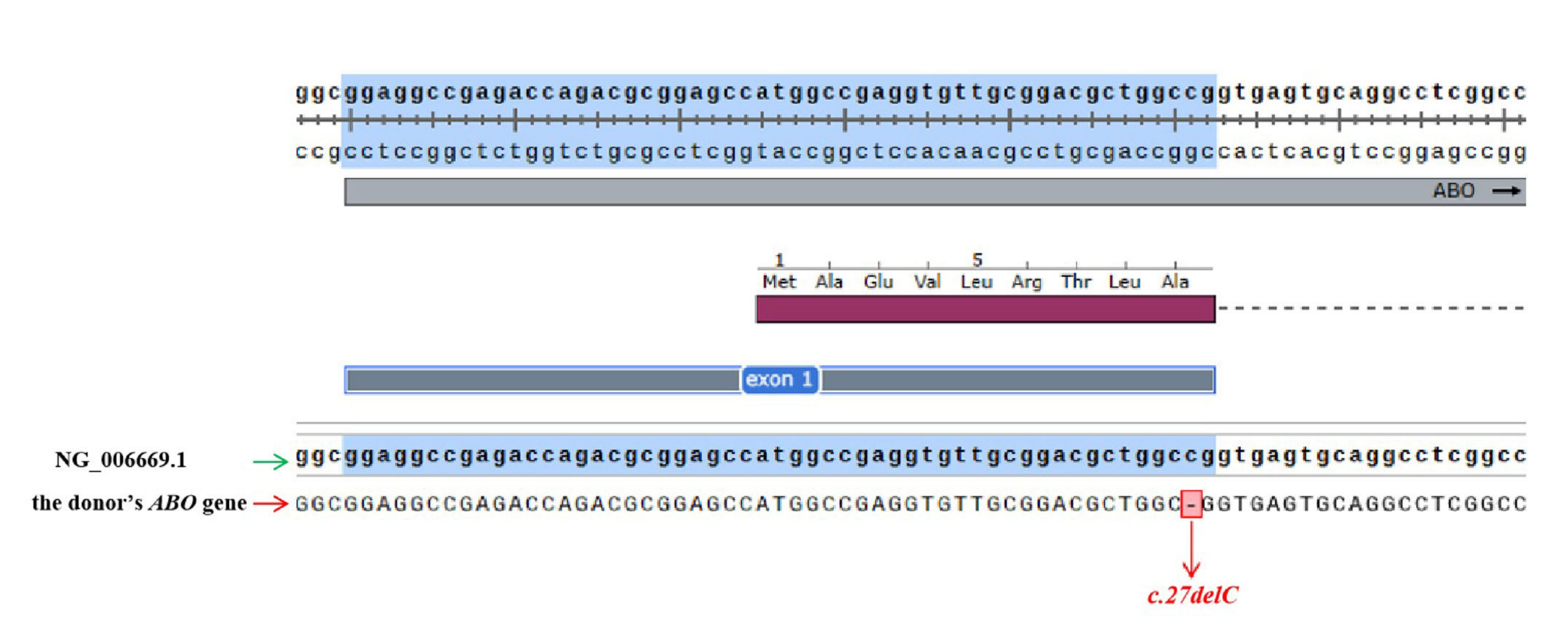
Case2: A new variant, c.27delC, in exon 1 of the ABO gene resulting in a weak B phenotype
Patient information:During routine blood group testing, we discovered an incongruity in the blood type of a 20-year-old adult female Han Chinese donor.
Serological testing:

Sanger Sequencing: ABO*O.01.02/ABO*B.01。
PacBio HiFi Sequencing (HemoSure®) : PacBio long-read single-molecule real-time sequencing indicated that on one haplotype the donor harboured the ABO*O.01.02 allele, whereas on the other haplotype there was a new variant in the B allele. This variant involved the deletion of the cytosine base at position 27 in exon 1 of ABO*B.01, leading to a synonymous variant at the ninth amino acid translation site.
Reference:Shao L, Ma L, Xiao JY, et.al. Transfus Med. 2025 Feb; 35(1):103-105.
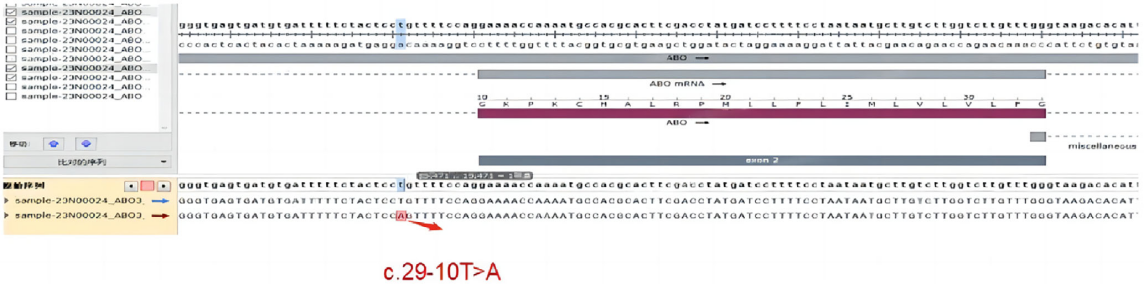
Case 3: Detection and phenotype analysis of a novel Ael blood group allele
Patient information:The proband is a 30-year-old Chinese man. Blood typing serology inconsistent with Landsteiner's Law.
Serological testing:

PacBio HiFi Sequencing (HemoSure®) : According to the sequencing results, by using real-time SMRT assay covering the full-length sequence and promoter region of the ABO gene, again we found this novel heterozygous mutation (c.29-10T>A) in intron 1 of the ABO gene. ABO gene-specific primers and PacBio RS sequencing confirmed that the intronic variant was located on the ABO*A1.02 allele. No variant gene was detected in the promoter region and +5.8-kb site of the ABO gene.
Reference:Wang C, Tang Y, Zhang P, et.al. VoxSang. 2024 Jan; 119(1):74-78.
Case 4: Identification of a B/O Blood Group Chimera
Patient information:33-year-old female with no relevant medical history. ABO typing discrepancy identified during routine maternal screening.
Serological testing: No agglutination with anti-A, mixed-field with anti-B and anti-AB, 4+ with anti-H. Reverse typing: 3+ with A1c, no agglutination with B1c. Antibody screening was unexpectedly negative.
Sanger Sequencing: ABO*O.01.01/ABO*O.01.01. No heterozygous mutation peaks at B SNP loci.
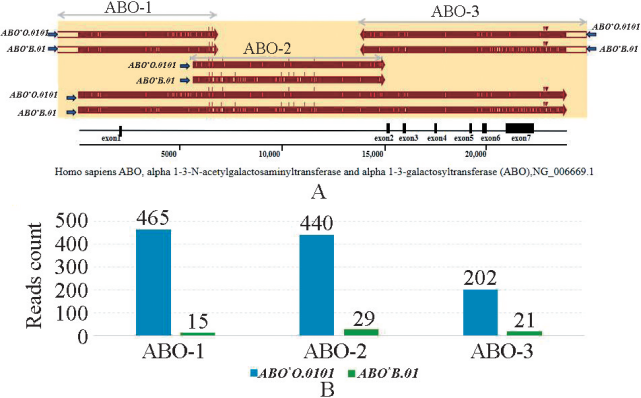
PacBio HiFi Sequencing (HemoSure®) : HemoSure® resolved two distinct haplotypes: ABO*O.01.01 and a low-read-count ABO*B.01 haplotype, with an order-of magnitude difference in read depth between them. This read disparity indicated the presence of partial ABO*B.01 chimerism in the patient.
Reference:Li R, Cui C, Hao X. B/O blood group chimera identified by PacBio third-generation sequencing: a case report. Zhongguo shuxue zazhi. 2025;38(3).


 WeChat QR Code