
A novel approach to simultaneous genotyping of human platelet antigen systems and human leucocyte antigen class I loci using PacBio long-read sequencing
Background and Objectives
Accurate human leucocyte antigen (HLA) and human platelet antigen (HPA) typing is essential for establishing a blood platelet donor bank to deal with refractoriness in patients undergoing multiple platelet transfusions. Current methods, such as Sanger and next-generation sequencing, encounter difficulties in haplotyping. Herein, the aim of this study was to establish a method for HLA and HPA typing based on the long read sequencing.
Study Design and Methods
The HPA and HLA class I genotypes of 268 platelet donors from the Taiyuan Blood Center, China were identified using long-read sequencing on the PacBio platform. Allele frequencies for HPA systems and HLA class I genes were calculated, and genetic variability within HPA system genes was analysed.
u In this study, a blood group gene panel was designed, encompassing 10 platelet transfusion-related genes, including the entire genes of HLA-A, HLA-B, HLA-C, GP1BA and GP9, GP1BB, and the core regions of ITGB3, ITGA2B, ITGA2 and CD109, covering HPA 1-35w.
u Single-molecule real-time (SMRT) libraries were prepared using a one-step method that integrates DNA damage repair, end-repair and adapter ligation reactions to generate pre-sequencing libraries with unique barcode adapters. The final library was prepared with sequencing enzymes and primers using Sequel Binding Kit 2.2 and Internal Control Kit 1.0. DNA-polymerase complexes at a concentration of 150 pM were then loaded onto the Sequel II platform (Pacific Biosciences, Menlo Park, CA, USA) for sequencing with a 20-h run time.
u To validate the accuracy of our findings, we randomly selected 60 samples from the 268 analysed in this study and cross-referenced the TGS results with Luminex assay results for HLA systems (HLA-A, HLA-B and HLA-C) and TaqMan assay results for six HPA systems (HPA-1 to HPA-5 and HPA-15).
Results
1. Distribution of HPA system
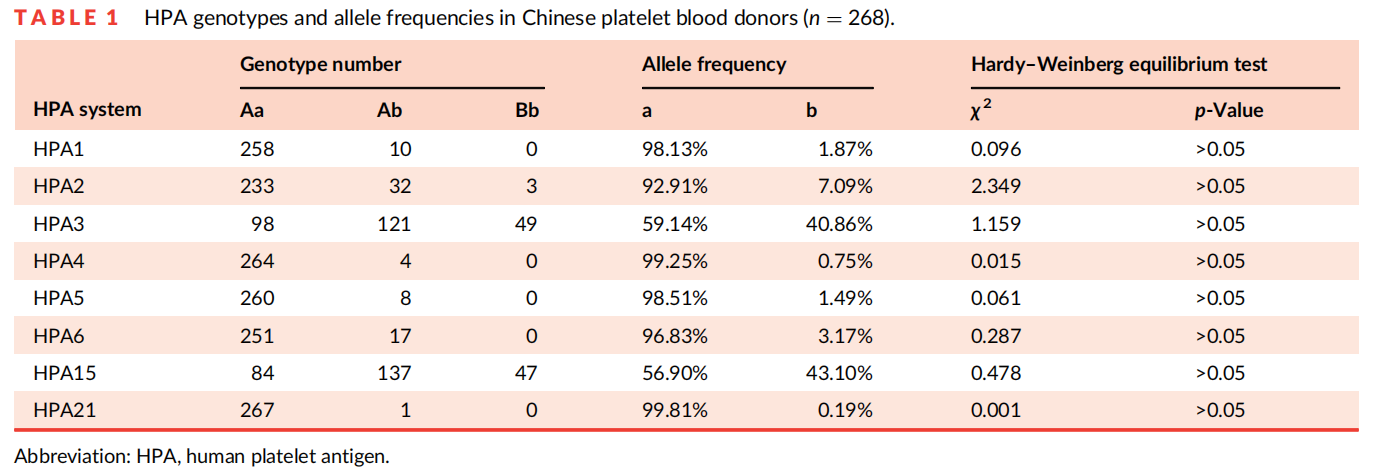
In this study, we utilized targeted TGS to identify genetic variations within the HPA and HLA systems. All data exhibited a read quality greater than 0.99, with read numbers consistently exceeding 100. To validate the accuracy of our findings, we cross-referenced TGS results with TaqMan assay results for six HPA systems (HPA-1 to HPA-5 and HPA-15) from a cohort of 60 samples, observing a 100% concordance rate. Polymorphisms were identified in the HPA systems HPA-1 to HPA-6w, HPA-15w and HPA-21w, while the remaining 27 HPA systems only exhibited the ‘aa’ homozygous form. The allele frequencies of HPA-1b to HPA-6b, HPA-15b and HPA-21b were 0.0187, 0.0709, 0.4086, 0.0075, 0.0149, 0.0317, 0.4310 and 0.0019, respectively, and all SNV distributions conformed to Hardy– Weinberg equilibrium (p > 0.05). The genotypes and allele frequencies of the systems exhibiting polymorphisms are summarized in Table 1.
2. Genetic diversity patterns within HPA system gene
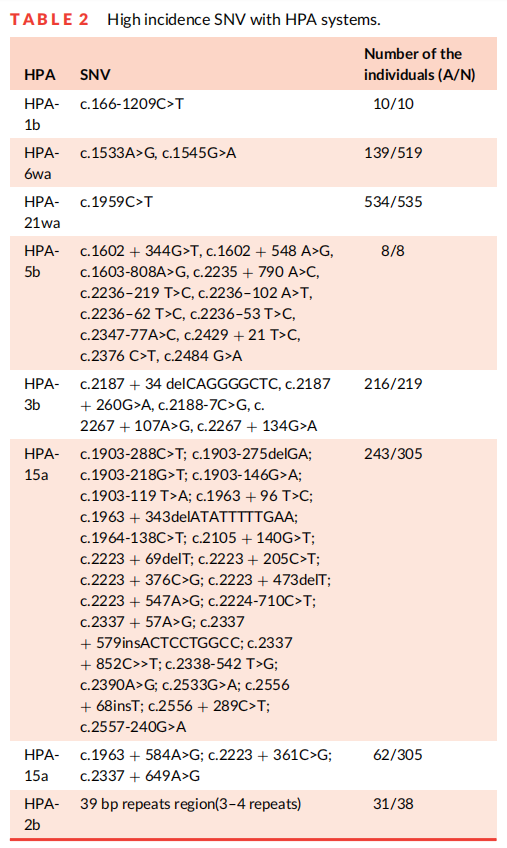
Despite extensive research into the polymorphism of HPA loci across various populations, the complete sequence patterns of each HPA-related gene have not been elucidated using haplotype sequencing. In this study, we initiated an investigation focused on the sequence patterns of HPA-related alleles within ITGA2. Our data indicate no linkage between HPA-1b and HPA-4b, as well as between HPA-6b and HPA-21wb. Intriguingly, we observed that the c.166-1029C>T variant was present exclusively in samples carrying the HPA-1b allele, suggesting it could serve as an auxiliary marker for HPA-1b screening (Table 2). A similar correlation was found between c.1959C>T and the HPA-21wa allele (Table 2). Besides, HPA-5b exhibits a distinct pattern characterized by variants c.2568G>A, c.2376C>T and c.2484G>A, along with several intronic variants (Table 2).
For the ITGA2B gene, the HPA-3b allele was observed to have a strong association with a series of intronic mutations, including c.2187 + 34_2187 + 42delCAGGGGCTC, c.2187 + 260G>A, c.2188-7C>G, c.2267 + 107A>G and c.2267 + 134G>A (Table 2). Within the CD109 gene, the HPA-15 allele displays two distinct patterns. The first pattern is characterized by a high incidence of the c.2533G>A variant and a series of intronic mutations associated with one HPA-15a allele. The second pattern is defined by the presence of the c.1963 + 585A>G, c.2229 + 361C>G and c.2337 + 649A>G variants (Table 2). Previous studies have reported the presence of one to four 39-base pair (bp) tandem repeats in the macroglycopeptide region of GPIbα. Our findings suggest that the HPA-2b allele is frequently associated with three to four repeats of this 39-bp sequence (Table 2), while HPA-2a samples contained 1–2 repeats of the 39-bp sequence.
3. Distribution for HLA class I loci
Our study comprehensively examined the full-length sequences of the HLA-A, HLA-B and HLA-C genes in 268 donors. To validate the performance of targeted TGS, we randomly selected 60 samples from these donors and performed HLA typing using the LABType® SSO Typing Test. The results showed 100% concordance between the two methods at both the first and second field levels of HLA typing. This study also identified previously unreported full-length genomic sequences for the alleles A*33:03, B*851:39, C*01:85 and C*15:26, which were not present in the current IPD-IMGT database. Our data indicate that A*02:01 is the most prevalent HLA-A subtype, with a frequency of 21.22%. For HLA-B, the most common alleles are B*51:01 and B*46:01, each with a frequency of 15.30%. At the HLA-C locus, C*06:02 is the most frequent allele, with a frequency of 16.39%.
Conclusion
In conclusion, we have successfully established a targeted long-read sequencing method based on amplicon technology, which enables the simultaneous genotyping of all 35 HPA systems as well as HLA-A, HLA-B and HLA-C loci. This method possesses the characteristics of high throughput, simultaneity and haplotyping capability. We reported the polymorphism of HPA systems and HLA class I and analysed the gene patterns and linkage of HPA-relative genes. Overall, we evaluated the feasibility of utilizing the Pacbio platform for HPA and HLA typing, particularly for platelet donor bank establishment.
Reference:Zhao P, Lyu Q, Xu Y, et.al. A novel approach to simultaneous genotyping of human platelet antigen systems and human leucocyte antigen class I loci using PacBio long-read sequencing. Vox Sang. 2025 Jan;120(1):63-70.


 WeChat QR Code